NBA Bet of the Day UK: Daily Picks and Premium Odds
Daily NBA picks for UK punters — line-shopped, edge-priced.
 Available in US
Eight years into pricing NBA slates from a desk in the UK, and I still remember the first time a Lakers tip-off pulled me out of bed at two in the morning to watch a line I had taken eleven hours earlier slowly migrate against me. The game hadn’t started. The injury report had. That single experience taught me more about NBA betting from a British seat than any strategy article I had read.
The “NBA bet of the day” is the daily ritual that comes out of that lesson. One pick, one slate, one honest read on where the line and the probability are actually mismatched. Not a parlay sold as a sure thing. A single, line-shopped, edge-priced call you can back or skip with a clear head.
The British NBA audience has earned this kind of treatment. Sky Sports viewership has climbed roughly 40 per cent since 2019, driven mostly by under-30s, and the NBA App has been downloaded over six million times across EMEA since its 2023 launch — UK viewership alone is up 52 per cent. This guide is for that audience: the British punter who already knows the league and wants the betting side treated with the same respect.
What you get
A daily NBA pick built from pace, efficiency and matchup data, line-shopped across UKGC-licensed books before publication.
UK timing
Picks posted in the UK afternoon, well before the East-Coast tip-off window opens at midnight BST.
How it’s priced
Implied probability, no-vig fair line, +EV check. If the model edge is under one per cent, no pick goes out.
Who it’s for
UK adults 18 plus, registered with UKGC operators, comfortable with decimal odds and willing to pass on a slate.
What you will read next is the full machinery: how a pick is built, which UK markets I lean on, why the 2025 integrity reset matters for your slip, and where I draw the responsible-play line.
Table of Contents
- Finding the Betting Edge in Six Lines
- What “Bet of the Day” Actually Means in NBA Markets
- Why UK Punters Need a Different NBA Playbook
- How We Build Each Daily Pick
- UKGC Bookmakers for NBA: A High-Level Map
- The Six Bet Types Behind Every NBA Slate
- Finding Value: Implied Probability, No-Vig and CLV
- Bankroll, Units and Why Kelly Is a Ceiling, Not a Goal
- The 2025 Integrity Reset and What It Means for Your Bet Slip
- The UK Regulatory Frame Around Your NBA Stake
- The UK Slate: How to Play NBA Across BST and GMT
- Playing Within Limits: Tools, Levies and Honest Self-Checks
- Frequently Asked Questions
- Reading Your Next Slate Like an Analyst
Finding the Betting Edge in Six Lines
- The 2025/26 season is running at a 30-year record pace of 101.9 possessions per 48 minutes — totals priced off last season’s reads are stale, and the over has been the sharper default early.
- An AI pick rated five stars by an industry model can hit 73 per cent, but a one-star read sits at 17 per cent — never bet a pick without seeing the confidence tier behind it.
- Since 22 December 2025, NBA injury reports update every 15 minutes — wait for the gameday window before pricing any prop.
- UK punters pay zero tax on winnings; the operator pays it on your behalf, which is why no-vig pricing matters more than coupon offers.
- Five UK books carry 50-plus markets per NBA game. Line-shopping across just three of them moves long-run ROI more than any tipster service.
What “Bet of the Day” Actually Means in NBA Markets
A friend asked me last winter, half-serious, whether “bet of the day” meant the bet I was most confident in or the bet I would actually place that day. Fair question. The honest answer is that for most sites it means neither — it means the pick that drives clicks. For a working analyst, it has to mean something tighter.
A real NBA bet of the day is one selection, drawn from that night’s slate, where the model price and the market price disagree by enough to justify a unit. The phrasing matters. It is not the highest-confidence pick on the board, because confidence and value are different animals. The Boston Celtics at 1.30 to win at home against a tanking team might be the most likely outcome on the slate — and a wretched bet, because the price is shorter than the true probability.
Confidence vs value, in one line
Confidence is “how often does this happen?” Value is “is the market paying me more than that frequency deserves?” A 60 per cent likely outcome at decimal 1.80 is +EV. A 75 per cent likely outcome at 1.30 is -EV. The bet of the day picks the first one every time.
The product, as I run it, has three components: the call itself (side, line, market), the price-and-book pair where that line is best-priced for a UK account, and the confidence tier — full unit, half unit, or no bet. A pick without all three is a tip, not a bet of the day.
That structure also lets the reader skip. Some nights the slate genuinely doesn’t produce a +EV call worth publishing — usually because line moves have already squeezed the gap before tip-off. A working analyst tells you that, instead of forcing a pick to fill the slot.
Implied probability — the percentage chance baked into a decimal odds price. A 2.00 line implies 50 per cent; a 1.50 line implies 66.7 per cent. Convert before you bet, not after.
One piece worth flagging: bookmakers have noticed how much contextual data influences slip decisions. Sportsbooks that put a relevant stat next to a market saw a 1.3 times jump in bet count and a doubling of average stake size. Translation: showing the why next to the what changes behaviour. That is exactly why a written bet of the day, with reasoning attached, beats a tipster screenshot every time.
Why UK Punters Need a Different NBA Playbook
An American friend sent me a tipster column last March. Top of the page: a glossy +180 underdog play with a “BetMGM PROMO CODE” splashed across it. BetMGM doesn’t accept UK accounts. The pick was 4 a.m. UK time. The “edge” leaned on a US-only same-game parlay boost. Three layers of irrelevance to a British reader, all in the first scroll.
The British NBA audience is no longer a niche. NBA App downloads across EMEA passed six million since the September 2023 launch, with UK-specific viewership up 52 per cent. NBA Europe social pages cleared 226 million views in a regular season, growing 23 per cent year on year, and Basketball England participation among 14-25-year-olds jumped 65 per cent since 2018. The crowd is here. The dedicated UK-focused betting analysis still isn’t.
The structural differences between a UK and a US NBA bet are not cosmetic. Three of them shape every pick I publish.
Vocabulary and product
British markets call the spread a handicap and the parlay an accumulator. The bet builder is what Americans call a same-game parlay, and even that overlaps imperfectly. A UK punter who reads US analysis without translation is constantly making small misreads.
Time zone reality
NBA games tip off between midnight and 6 a.m. BST during the bulk of the season. The UK working punter is rarely awake for the main slate. That changes everything: pre-bet timing, injury report alignment, even which markets are realistic to play live.
Operator landscape
UK accounts are with UKGC-licensed operators. The compliance stack — affordability, source-of-funds checks, the new statutory levy, BeGambleAware messaging — is materially different from a New Jersey or Pennsylvania account. Online sports betting accounted for 56.64 per cent of UK online gambling revenue in 2024, the largest vertical. Every pick has to be placeable inside that frame.
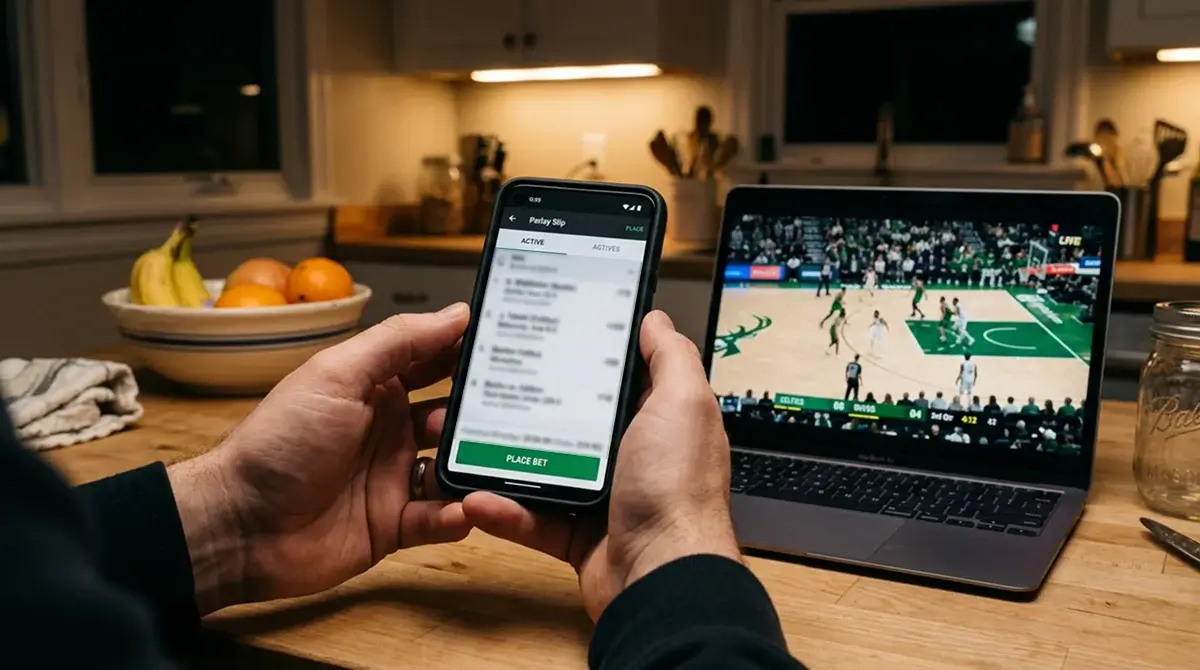
71 per cent of UK online bets in 2025 were placed from mobile devices, up from 58 per cent in 2021. Among 18-24-year-olds, the mobile share hits 76 per cent. The bet of the day has to read on a phone, in two minutes, on the train.
This is also why I push readers toward the broader NBA betting tips for UK punters guide — operator-side detail, market depth comparisons, welcome-offer fine print. The pillar you are reading anchors the daily product. The UK-specific playbook fills in the practical layer beneath it.
How We Build Each Daily Pick
The fastest way to lose money on the NBA is to pick a side first and rationalise it afterwards. Every analyst I respect builds in the opposite direction — model first, market second, narrative dead last. What follows is the actual sequence I run, in order, every UK afternoon before publishing.
Start with the slate, not the games. The 2025/26 NBA season is unlike anything I have priced in eight years. The first ten days produced a league-average 117.7 points per team per game — the third-highest figure in NBA history and the highest in 64 seasons. Pace sits at 101.9 possessions per 48 minutes, a 30-year record across the entire play-by-play data era. League-wide offensive efficiency has climbed to 114.3 points per 100 possessions, near the all-time high of 114.5. None of those numbers can be ignored when you sit down to price a total.

The five-stage pricing sequence
Stage 1 — Pace and efficiency: Take each team’s possession-per-48 figure, average them, then multiply by combined offensive efficiency. That gives a raw points projection before context.
Stage 2 — Schedule weight: Adjust for back-to-backs, travel days, time-zone shifts and rest gaps. A team on its second night in three days drops measurable efficiency in the fourth quarter.
Stage 3 — Roster status: Apply the latest injury report. Since 22 December 2025, that means waiting for the gameday window — the 8-10 a.m. local-time report for early tip-offs, the 11 a.m.-1 p.m. window for evening games.
Stage 4 — Market scan: Pull prices from at least three UKGC-licensed books. Convert to implied probability. Strip the vig. Compare to the model.
Stage 5 — EV gate: If the no-vig model edge is under one per cent on moneyline or under half a point on totals, no pick. The slate gets skipped.
Stage 5 is the one most readers underrate. A model that produces a pick every single day is a model that has been quietly relaxed to fit the publishing slot. Real edge is rarer than the daily news cycle. Roughly one slate in four during a typical week, the gap between my model and the market is too thin to publish — and saying so out loud, in print, is part of the product.
One additional layer matters: which 19 per cent of the game actually decides the bet. Across an analysed sample of 2,295 NBA games, 19 per cent of outcomes are decided in the fourth quarter, where pace slows to 90-100 possessions and fatigue measurably reshapes efficiency. Totals bets in particular live or die in those final 12 minutes.
Before any pick is published
- Pace and efficiency model run against the current 30-day window.
- Injury report cross-checked against the latest 15-minute update.
- Prices pulled from at least three UKGC-licensed books.
- No-vig fair line calculated; edge measured against best available price.
- Confidence tier assigned: full unit, half unit, or no bet.
Industry models that publish ratings openly report tier-by-tier accuracy: a five-star pick on one widely-cited US system hits 73.43 per cent, four-star hits 60 per cent, and one-star sits at 17 per cent. Those numbers are useful for context, not blind faith. The market knows what you know — that is why the price is what it is.
UKGC Bookmakers for NBA: A High-Level Map
I keep accounts at five UK books, and the only reason it is five is that the market is genuinely fragmented enough to justify them. A new reader once asked me whether one operator is “the best” for NBA. The honest answer is that the question is the wrong shape. UK NBA betting is a line-shopping discipline — the five-book answer is forced on the punter by the market itself.
The basic facts of the UK market: the gambling industry in Great Britain produced a Gross Gambling Yield of £16.8 billion across the financial year ending March 2025, a 7.3 per cent rise on the previous year. The online sector — remote casino, betting and bingo combined — generated £7.8 billion of that, up by more than £900 million, and now accounts for 46 per cent of the total. Within remote betting specifically, the GGY hit £2.4 billion. Football still dominates that pool at £1.1 billion, and horse racing follows at £771 million.
Five UK-licensed operators carry the deepest NBA menus by market depth: bet365, William Hill, BetVictor, Unibet and Betfred each post 50-plus markets per game. Sky Bet and Paddy Power round out the practical shortlist. Flutter Entertainment, the parent of Sky Bet and Paddy Power, reported group revenue of $15.91 billion across 2025 — a 17 per cent rise on 2024 — which gives some sense of the financial scale behind these front-ends.

This pillar names operators only as facts of the market. The structured side-by-side that does the practical comparing — market depth, live streaming, welcome-offer fine print — runs in the dedicated cluster on UK NBA betting tips.
What separates them in practice
Three differentiators actually move the needle for a daily NBA bettor: market depth, in-play streaming and early-payout features. Market depth means how many lines per game the book actually posts — not just moneyline and spread, but second-half spreads, quarter totals, alternative player props, race-to-X-points, double-result. Five UK books push past the 50-market threshold. Two or three sit comfortably under it.
In-play streaming is the second axis. NBA UK rights fragmented in the 2024 media deal: Sky Sports holds the 11-year anchor contract starting 2025/26; Amazon Prime Video carries 86 regular-season games per year along with the NBA Cup and several Conference Finals series. A handful of UK books layer their own streams on top, accessible to logged-in account holders with a funded balance.
Early payout features are the third. Two UK operators — bet365 and BoyleSports — offer 17- and 20-point early-payout on NBA spreads. Paddy Power and BoyleSports lead on acca insurance. None of these are reasons in themselves to choose a book, but they all matter at the margin across a season.
Market depth
50+ markets per NBA game across five UKGC operators. Below that threshold, bet builders and prop variety thin out fast.
Live streaming
Bookmaker streams supplement Sky and Prime. Latency varies; lag against a TV feed can run into double-digit seconds.
Early payout
17- and 20-point early payouts on NBA spreads exist at a handful of UK books. Read the small print on minimum bet size.
Acca insurance
One leg lets you down on a five-fold? A short list of UK books refunds the stake as a free bet, not cash. Cap usually applies.
The Six Bet Types Behind Every NBA Slate
If a new bettor asked me to teach them the NBA market in fifteen minutes, I would not start with strategy. I would start with vocabulary. Six bet types do nearly all the work on a UK NBA slate, and the difference between an informed bettor and a gambler is mostly that the informed one can name them clearly and pick the right one for the situation.
The remote betting market in the UK turned over £570 million in real-event GGY across the April-June 2025 quarter, down 9 per cent on the year prior. Within that pool NBA volume is rising, and the bet-type mix has shifted noticeably toward props and bet builders since the 2024 media deal expanded coverage.

The six types, defined
Moneyline — the straight match-winner bet. Pick which team wins, no margin attached. UK books often label it “match winner”.
Handicap — the British term for the spread. The favourite “gives” points to the underdog; you bet on which side covers the adjusted margin.
Totals (over/under) — bet whether the combined points scored go above or below a set number. The 2025/26 pace surge has pushed totals higher than any prior NBA season.
Player props — bets on an individual player’s stat line: points, rebounds, assists, threes made, or combinations like PRA. Prop volume has exploded in the last three years.
Accumulator — multiple selections combined into one slip; all must win. UK books call them accas; American books call them parlays. Same product, same maths.
Bet builder / SGP — combines several legs from a single game into one slip. UK books call it a bet builder; the US calls it a same-game parlay. Pricing accounts for correlation between legs.
Where each type fits
The right bet type depends on the read, not the mood. Moneyline is for upsets and live-betting swings. Handicap is the workhorse — most professional NBA bettors live on it because the half-percent edges accumulate cleanly. Totals are where the 2025/26 pace data has the most leverage; the over has run sharper than the market is pricing because most books are still calibrating to last year’s pace baseline. Player props are where the post-scandal landscape has shifted hardest. Accumulators feel exciting and price terribly — every additional leg compounds the vig. Bet builders, used surgically, can find correlated edges; used carelessly, they’re worse than accas.
✓ Do
- Treat moneyline and handicap as primary tools — props and accas as supplementary.
- Match the bet type to the read: pace play goes in totals, role-change goes in props.
- Always check the no-vig fair line before backing any market.
- Cap your accumulators at three or four legs to stay inside reasonable variance.
✗ Don’t
- Pile six legs onto an acca because the headline odds look fun.
- Touch a player prop without checking the latest 15-minute injury update.
- Take a bet builder where two legs are clearly correlated and the price doesn’t reflect it.
- Confuse a high-confidence pick with a high-value pick.
Each of these six types deserves its own deep dive. Spreads and totals live inside the NBA spread and totals betting guide. Props get the structural treatment in NBA player props betting. Accumulators and bet builders are the focus of NBA accumulator betting.
Finding Value: Implied Probability, No-Vig and CLV
The single most expensive habit I see among UK NBA bettors is reading odds without converting them. Decimal 1.91 looks like one number; what it actually is, after the bookmaker’s margin gets stripped out, is roughly a 50 per cent fair-line probability. Two punters can stare at the same price and walk away with completely different reads, depending on whether they did the conversion in their head.
Implied probability from decimal odds
Formula: implied probability = 1 / decimal odds.
1.91 gives 1 / 1.91 = 0.5236, or 52.4 per cent implied.
2.50 gives 1 / 2.50 = 0.40, or 40 per cent implied.
1.30 gives 1 / 1.30 = 0.7692, or 76.9 per cent implied.
The implied probabilities on a two-way market always sum to more than 100 per cent. The excess is the bookmaker’s margin — the vig. On a typical NBA moneyline, the two implied probabilities might sum to 105 per cent. That five points of overround is what the book takes regardless of who wins, and it has to come out before any honest assessment of value.
Stripping the vig (no-vig fair line)
Lakers 1.91 implies 52.4 per cent. Opponent 1.91 implies 52.4 per cent. Sum: 104.8 per cent.
Divide each side by the sum: 52.4 / 104.8 = 50.0 per cent fair probability for each team.
Now compare that 50 per cent fair line to your model. If your model says the Lakers should win 53 per cent of the time, you have a three-point edge at this price.
That three-point edge is what +EV — positive expected value — actually looks like in practice. Not a feeling about a team. A measurable gap between your probability estimate and the market’s. The whole point of pace, efficiency, injury and matchup work is to produce a probability number that the market does not yet have.
The catch — and there is always one — is that your model needs to be honest about its own accuracy. Plenty of room for a 60 per cent confidence read to actually settle around 55 per cent over a long sample. Half the discipline is staking smaller when your edge is uncertain rather than convincing yourself you’ve found a 10-point gap.
Closing line value
The single best long-run signal that you’re picking sharply is closing line value, or CLV. The concept: if you take Lakers at 1.91 in the afternoon, and the line closes at 1.85 by tip-off, the market has moved toward your side. You “beat the close”. Across hundreds of bets, CLV correlates more tightly with long-run ROI than any single-game outcome does. A bettor who consistently posts positive CLV is, by definition, finding edges before the market prices them in.
Tracking CLV across UK books is one of the highest-leverage habits in the discipline. The implementation detail — what counts as good CLV, how to log it without third-party software, when to interpret the data — gets a deeper treatment elsewhere. The pillar-level point is simpler: if you only track one number across your NBA betting season, track CLV.
Bankroll, Units and Why Kelly Is a Ceiling, Not a Goal
“How much should I bet?” is the question I get most often, and it is almost always asked too late — after the slip is on, sometimes after it has lost. The serious answer is unromantic: the size of your bet should be decided before you ever look at the odds, and it should be a function of your bankroll and your edge, in that order.
A bankroll, properly defined, is money you have already mentally and financially separated from your daily life. Rent money is not bankroll. Holiday savings are not bankroll. The figure has to survive losing 100 per cent of itself without the rest of your finances flinching. Mobile mechanics make this harder, not easier. 71 per cent of UK online bets in 2025 came from mobile, and 95 per cent of UK online gambling happens from home. The friction between thinking and betting has been engineered down to a single tap. The structure has to come from your side.
The unit, defined
A unit is a fixed percentage of your bankroll — typically one or two per cent. Not a fixed pound figure. If your bankroll grows or shrinks materially, the unit recalibrates. A £10 unit on a £1,000 bankroll becomes a £12 unit on a £1,200 bankroll and an £8 unit on an £800 one.
Flat units and why they win arguments
The default staking method that survives variance is flat unit betting. Every “full unit” pick gets the same stake. Half-unit speculative picks get half. The simplicity is the strength: you can run flat units for two seasons without a calculator, and the variance smooths into something readable. Flat units also protect you from the most common cognitive trap in betting: scaling stakes upward when you “feel hot” and downward when you “feel cold”. Variance creates streaks that look like patterns but aren’t.
Fractional Kelly as a ceiling
The Kelly criterion is the maths-pure answer to optimal stake sizing: bet a fraction of your bankroll proportional to your edge divided by the odds. The formula is correct. Almost no one should run it at full strength. Full Kelly assumes you know your edge precisely. You don’t. Nobody does.
Half-Kelly — and more often quarter-Kelly — exists exactly because edge estimation is uncertain. A half-Kelly stake gives you most of the long-run growth of full Kelly with a fraction of the drawdown risk. The detailed Kelly mechanics — the formula, fractional variants, why edge estimation error matters — sit inside the NBA betting strategy and bankroll guide. The pillar-level rule: never bet more than half-Kelly suggests, and almost always bet less.
UK affordability checks now trigger at £150 per 30-day rolling period for financial vulnerability indicators. That threshold lives upstream of any Kelly maths, and it is there for a reason.
The 2025 Integrity Reset and What It Means for Your Bet Slip
On 23 October 2025, 34 people — including current and former NBA players and head coach Chauncey Billups — were arrested and charged in a federal sports-betting and poker fixing case. Most British coverage treated it as a foreign curiosity. It is not. It changed how UK punters interact with NBA markets, and the changes are now hard-wired into the schedule of every game I price.
Adam Silver, the NBA Commissioner, framed the league’s position bluntly. “If this game isn’t viewed as being honest and the competition being on the level and at the highest integrity, over time we will lose our fan base. I have no doubt about that.” His earlier remarks went further on the structural cause: “It’s too easy to manipulate something which seems otherwise small and inconsequential to the overall score. There’s nothing more important than the integrity of the competition.”

Two operational changes followed, and both reach into the UK punter’s slip.
The 15-minute injury report rule
On 22 December 2025, the NBA introduced an updated injury-report regime. Reports must now be updated every 15 minutes — down from the prior one-hour cadence — once filed. A new gameday report window was added between 11 a.m. and 1 p.m. local time. For matches with a tip-off at or before 5 p.m. local, the report window moves earlier, between 8 a.m. and 10 a.m. The structural intent is to give markets less time to be exploited by privileged information.
For a UK bettor, the timing translation matters. East-Coast tip-offs at 7 p.m. local mean a midnight UK kickoff. The 11 a.m.-1 p.m. local report window converts to 4 p.m.-6 p.m. UK time — directly inside the window when most British punters are checking their slips. Pricing a player prop before 4 p.m. UK is now demonstrably worse practice than waiting an extra hour.
Prop limits on two-way and 10-day contracts
The second change is quieter but reaches further. After the earlier Jontay Porter scandal in 2024, several US books voluntarily pulled props on players holding two-way or 10-day contracts. The 2025 indictments accelerated that. UK books, operating under UKGC integrity oversight rather than US state regulators, have moved at varying speeds. Some matched the US pull immediately. Others kept their menus broader. The moving boundaries get tracked in detail in the player props cluster.
The earlier Rozier review, in context
Before the federal indictments landed, the NBA had previously conducted an internal review of Terry Rozier following nationwide alerts from US Integrity in March 2023. That review, the league publicly stated, “did not find a violation”. The October 2025 federal case was a reminder that internal reviews and federal investigations are different instruments.
What changed for the daily bet of the day? Three things. First, no prop pick goes out before the gameday window confirms personnel. Second, two-way and 10-day-contract players are off the prop board entirely until the broader market posture stabilises. Third, every published call now carries an integrity caveat — not because I expect a fix tomorrow, but because the post-2025 environment demands the punter understand what they are participating in.
The UK Regulatory Frame Around Your NBA Stake
British punters have a habit of treating regulation as something distant and bureaucratic. Then their account gets a financial-vulnerability flag and the conversation suddenly becomes very personal. The frame around your NBA bet is not abstract — it shapes deposits, withdrawals, account verification, the markets you can access, and increasingly the prices themselves.
The Gambling Commission, the UKGC, sits at the centre of this frame. Andrew Rhodes, then Chief Executive, opened his February 2025 address to the Betting and Gaming Council AGM with the topline numbers: “Recent data published shows that total Gross Gambling Yield is at its highest ever level at £15.6 billion. Participation in gambling has remained stable at 48 per cent, just under half of the adult population in Great Britain.”
The taxation layer
UK bettors do not pay tax on winnings. The duty is collected at the operator level. Provisional H1 2025/26 figures from HMRC put combined betting and gaming receipts at £1,786 million for the April-August window — £153 million higher than the same period a year earlier, a 9 per cent rise. General Betting Duty receipts for the full FY 2024/25 hit £714 million, up from £654 million the previous year. The Remote Gaming Duty is scheduled to rise from 21 per cent to 40 per cent in April 2026 — a change that will touch online casino margins more sharply than sports betting margins, but operators across the board will be re-examining pricing.
Affordability and financial vulnerability
Since 28 February 2025, financial-vulnerability thresholds for UK operators have dropped to £150 across a 30-day rolling period. Cross that threshold against certain risk indicators, and an affordability check can be triggered. The pilot of formal Financial Risk Assessments continues. The intent is harm-prevention. The practical experience varies — some checks are frictionless, others require document submission.
UKGC enforcement extends well beyond affordability. Crime and integrity prosecutions through the Commission have risen 300 per cent year on year. Rhodes told a 2025 industry briefing on illegal-market enforcement: “There will be no more warnings for those actors. I’m not talking about you, I’m talking about providers who may be also servicing the illegal market. There will be no warnings.”
Slot stake limits and where sport sits
The £5 online slot stake limit (£2 for 18-24-year-olds) introduced in the recent regulatory cycle does not apply to sports betting. NBA stakes remain operator-set within UKGC frameworks. But the broader White Paper reform agenda, including the new statutory levy on operators, sits behind every modern UK bookmaker’s risk and product decisions.
The UK Slate: How to Play NBA Across BST and GMT
The British NBA bettor has a problem the American one does not: the games are nocturnal. East-Coast tip-offs at 7 p.m. local mean midnight UK time. West-Coast 7 p.m. starts mean 3 a.m. UK. By the time the bulk of any night’s slate is decided, most British punters are asleep. That single fact reshapes how a daily pick has to be timed.

Sky Sports and Amazon Prime split UK NBA rights in the 2024 media deal. Sky has the 11-year anchor contract beginning 2025/26. Amazon Prime carries 86 regular-season games per season, the NBA Cup, the Conference Finals series and the NBA Finals across six of the next 11 years. Layered above both, NBA League Pass remains available for UK subscribers wanting full coverage. The streaming reality is unrecognisable from a decade ago, and 52 per cent UK App viewership growth since the 2023 launch reflects that.
What this means in practice for the bet of the day is simple: the call has to be placed before bed. Live in-play betting on a 4 a.m. tip-off is not realistic for the working bettor. The pre-game slip carries the entire weight of the decision.
That timing reality has practical implications worth structuring around. Three windows define the British NBA betting day.
The early window
East-Coast games at 7 p.m. or 7.30 p.m. local time — midnight or 12.30 a.m. UK — are the most realistic to engage with. The injury reports have all settled. Lines have run their pre-game adjustments. A British punter can place a bet at 11 p.m. and watch the first half before sleep. This is where most of my published bets of the day sit.
The brutal window
West-Coast 7 p.m. tip-offs land at 3 a.m. UK. These games are realistic to bet but not realistic to watch live. The line has to do all the work. Markets stay sharp overnight on big-volume games but drift on thin volume — which is its own opportunity if you can be awake for it.
The weekend double-header
Saturday and Sunday afternoon ESPN broadcasts often carry showcase games at 1 p.m. local — 6 p.m. UK. These are the genuinely UK-friendly windows. Family-time slots, Sky Sports prime hours, full audience. The pricing reflects it: lines are typically efficient, but volume on the big-name markets (Lakers, Warriors, Celtics) is high enough that mispricings on secondary markets — second-half spreads, less-followed prop lines — sometimes survive into tip-off.
British Summer Time and Greenwich Mean Time switch in late March and late October. NBA tip-off times in UK terms shift by an hour twice a season. Worth flagging in your calendar — the difference between a 12.30 a.m. and a 1.30 a.m. game changes whether you watch the start.
Playing Within Limits: Tools, Levies and Honest Self-Checks
The hardest paragraph for a betting analyst to write honestly is this one. The pressure to soften the harm side of the conversation is constant — sponsors don’t love it, search rankings don’t love it, the algorithm doesn’t surface it. I am writing it anyway, because the punters who read this guide are the ones I want to still be reading it five years from now.
Zoë Osmond, the Chief Executive of GambleAware, put the underlying truth cleanly in early 2025: “No form of gambling is completely without risk. However this new research shows that there are some particular types of gambling which can lead to an increased chance of experiencing gambling harm, which can have a corrosive effect on people’s lives, finances, careers and relationships.” That is the frame. NBA betting is not the highest-risk product on the market — that distinction belongs to electronic gaming machines and online slots — but it is not zero-risk either.
The numbers are worth seeing. GambleAware research conducted with Bournemouth University, published in early 2025, found that 79 per cent of those scoring at PGSI 1 or above played electronic gaming machines, 71 per cent placed retail sports bets outside football, horse and dog racing, and 63 per cent played online casino. A separate March 2025 GambleAware/YouGov nationally representative survey put problem gambling at 2.8 per cent of the UK adult population — significantly higher than the 0.5 per cent figure in some official UKGC reporting.
Honest self-checks are not a checklist. They are a question I ask myself every Sunday night before the week’s slates begin: am I betting the slate I planned to bet, or am I betting something more, faster, larger? If the answer drifts, the slate gets paused. Every UK operator offers deposit limits, time-out periods, and self-exclusion. GAMSTOP covers all UKGC-licensed operators in a single national self-exclusion register. The tools exist; using them is the practice.
The honest test
Before placing any NBA bet: am I within my pre-set bankroll, am I within my pre-set monthly stake limit, and have I gone more than five days without a break? If the answer to any of those is no, the slip stays empty.
If the conversation is moving past these tools, the right next step is a human one. Support organisations exist — GamCare, GambleAware itself, BeGambleAware messaging — and the UK ecosystem of free, confidential help is genuinely better than most countries.
Frequently Asked Questions
Five questions land in my inbox more than any others. They cover almost the full surface of what a new UK NBA bettor needs to settle before placing anything serious. Andrew Rhodes, speaking at an industry briefing in early 2025, captured one underlying trend worth keeping in mind: “Discussions with operators are showing a widening out of the sports offering in particular, with sports beyond the traditional horseracing and football growing in use, such as cricket, basketball, NFL and a host of other US-based sports.” NBA is part of that widening. The questions reflect it.
What is the NBA bet of the day, and how is it picked?
The NBA bet of the day is a single selection, drawn from the night’s slate, where the model price diverges from the market price by enough to justify a unit. It is not the most likely outcome — confidence and value are different things — and it is not always published. If the gap between the model and the no-vig fair line is too thin, no pick goes out. The methodology runs five stages: pace and efficiency modelling, schedule weighting, roster status using the latest 15-minute injury update, market scan across at least three UKGC books, and a strict EV gate before publication.
What time are NBA bet of the day tips posted in the UK?
Picks are typically posted in the late UK afternoon — between 5 and 8 p.m. UK time — well before the East-Coast tip-off window opens at midnight BST. The timing is deliberate. The 11 a.m.-1 p.m. local NBA gameday injury report falls inside the 4 p.m.-6 p.m. UK window, so any prop pick has to wait for that confirmation. Picks for late West-Coast games are sometimes posted later in the evening once additional roster information surfaces. The discipline: never publish a pick before the latest reliable injury read is in.
Which UK bookmakers are best for NBA betting?
“Best” depends on what you value. Five UKGC-licensed operators carry 50-plus markets per NBA game — bet365, William Hill, BetVictor, Unibet and Betfred — and Sky Bet plus Paddy Power round out the practical shortlist. Differentiation comes through market depth, live streaming availability, early-payout features (17- and 20-point on NBA spreads at a couple of operators), and acca insurance. Line-shopping across at least three UK books is the more important habit than picking a single “best” one. The dedicated UK NBA betting tips guide on this site walks through the operator comparison in detail.
Is NBA betting safe and legal in the UK?
Yes — NBA betting through UKGC-licensed operators is legal for UK adults aged 18 and over. The UKGC sets and enforces operator standards including affordability checks (financial-vulnerability thresholds at £150 across 30 days as of February 2025), self-exclusion through GAMSTOP, deposit limits, and source-of-funds verification. Crime and integrity prosecutions through the Commission have risen 300 per cent year on year, reflecting active enforcement. UK punters do not pay tax on winnings; the duty is collected from operators. BeGambleAware messaging on every UK book points to free confidential support if the activity stops feeling controlled.
How do I find value (+EV) on NBA picks?
Convert decimal odds to implied probability — 1 divided by the odds. Strip the bookmaker’s vig by dividing each side’s implied probability by the sum of both sides. The result is the no-vig fair line. Compare that fair-line probability to your own model probability, drawn from pace, efficiency, matchup and injury data. If your model says 53 per cent and the fair line says 50 per cent, you have a three-point edge. Track closing line value across your bets to confirm whether your edge is real over time. Line-shopping across multiple UK books captures additional value at the margin.
Reading Your Next Slate Like an Analyst
One pick. One process. One honest read.
The next slate that drops onto your phone deserves the same five-stage treatment every slate gets here: pace and efficiency, schedule, roster, market scan, EV gate. Skip when the gap is thin. Bet small when the edge is uncertain. Track CLV across the season and let the long-run signal tell you what your short-run feelings can’t.
Created by the ”bet of the day nba” editorial team.